vamos a ver...
Open Data And Open Software
How does open data and open software relate?
At a recent event I was told that open data is
independent from open software. While that at the first
moment seems to be true, on a second thought it gets
far more complicated.
Yes, you can have open data in an open data format and
load it into a proprietary software. You can work with
the data. And then you may or may not be able to get
your results out of it again. It is not up to you, it
is up to the software. It may decide that export is
only possible to closed data formats. Which means that
you entered a dead end, or cul-de-sac like they say
here in Ireland.
Using open software, there should not be such a dead
end. Open software depends on open data formats
(because closed data formats are not free, may have to
be reversed-engineered from documents which means that
they are not complete, can be changed from one day to
another by the owner, etc). And even if a piece of open
software does not offer data export possibilities, no
one can restrict you from having a look at the source
code and write an exporter himself.
So, yes, open data is possible without open source, but
it is a dead end. And what use is open data if it can
not be used to publish new insights?
Funny Ubuntu Problem
Just had a funny Ubuntu problem:
I could not log in with my (valid) password if the
screen was locked. But I could log in if I then
switched to the „switch user“ screen and selected the
same user. Reason: /etc/shadow had no rights granted,
instead of -rw-r------…
DCM Model Renderer
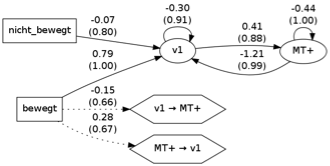
I have added a simple DCM model renderer script called
dcm2dot to my
SPM Hacks
page.
With this function DCM model files (DCMxxx.mat) will
be analysed and their network written out as
Graphviz
.dot files. You then can use graphviz small programs
like dot to render the network to PNG, PDF, SVG, etc.
Here a simple example of a V1-MT+ DCM:
Parallel DCM Model Estimation
I have added a short script that will estimate all available DCM models within a directory to my SPM Hacks page. This is a simple way to get parallel DCM Model estimation without a dedicated PC cluster and works also with multiple PCs if you put the files on a network file system. Note however that matlab uses one licence per user per PC, so you may run out of licences fast. But if you have a 8 core Linux PC you may be able to estimate 8 models at the same time in 8 matlab sessions using just one licence.
Adios Safari. Bienvenido Firefox.
There was a time when
Safari
was the fastest and the best webbrowser on the mac. It
was my default browser for more than 3 years. But one
thing has changed it all:
Flash.
It started small, like only one annoying flash applet
on webpages that I used to read. It wasn't doing much
that could not be achieved with animated gif or png.
Apart from eating like 100 times the CPU power.
It did not worry me that much, I could set most of them
to "hidden" with my user stylesheet in Safari. I did
not notice that people all around me started cutting
down the number of open pages in their browsers to only
one, so that their computer did not slow down to a
crawl.
But now the times have changed. Webdesigner startet
using not only more and more flash-applets per page,
they also started hiding them in the code, making it
hard to filter them by CSS. The last drop was the
switch to javascript based flash inclusion to bypass
the filtering on the side of the user.
Within the last three months using Safari on my Mac has
turned into a nightmare of slowliness. I could not
switch of Javascript because I need it, and I could not
switch of Flash because I also need it. Safari does not
let me filter flash. What could I do?
Switch to
Firefox.
Install the
Flashblock-addon.
And there is no step three.